
Clawdbot's Viral Success: The Era of Fully Autonomous AI Agents Has Arrive
The star of the latter half of January was not a new model, but an open-source AI assistant project named after a lobster — Clawdbot. Its selling point is simple yet highly imaginative: an AI Agent that runs locally or on a private server, capable of automatically helping you with:
· Operating applications and web browsers
· Managing files and schedulesWriting and deploying code
· Coordinating tasks across multiple software programs
In other words, it is not a "chatbot" but a true digital assistant that takes action for you.
Within just a few weeks, the project's popularity on GitHub skyrocketed, amassing over 120K stars and becoming the fastest-growing AI project, surpassing renowned open-source projects like "AutoGPT" and "Stable Diffusion." The developer community quickly produced a flood of plugins, custom versions, and tutorial videos. On social media, people even began using the term "Jarvis moment" to describe the experience.
However, Clawdbot's explosive popularity also brought significant confusion and risks. Due to naming and brand disputes, the project underwent a series of rapid name changes. First, following a protest from Anthropic (whose AI is named Claude, with a similar pronunciation), Clawdbot was renamed to Moltbot, meaning "lobster molting." However, after its domain name was maliciously registered, it ultimately settled on the name "OpenClaw."
Beyond the naming controversy, Clawdbot introduced more serious security risks. It requires high-level permissions, akin to a person operating a computer. When an AI is granted access to file systems, browsers, development environments, and even corporate internal systems, the risks escalate beyond mere "hallucinations" to creating a real attack surface. Many users attempted to mitigate these risks by purchasing dedicated devices like Mac Minis to run and isolate Clawdbot independently. Yet, risks of information leakage and "Trojan horse" attacks remain unavoidable. For average users lacking strong protective measures, now might not be the right time to experiment.
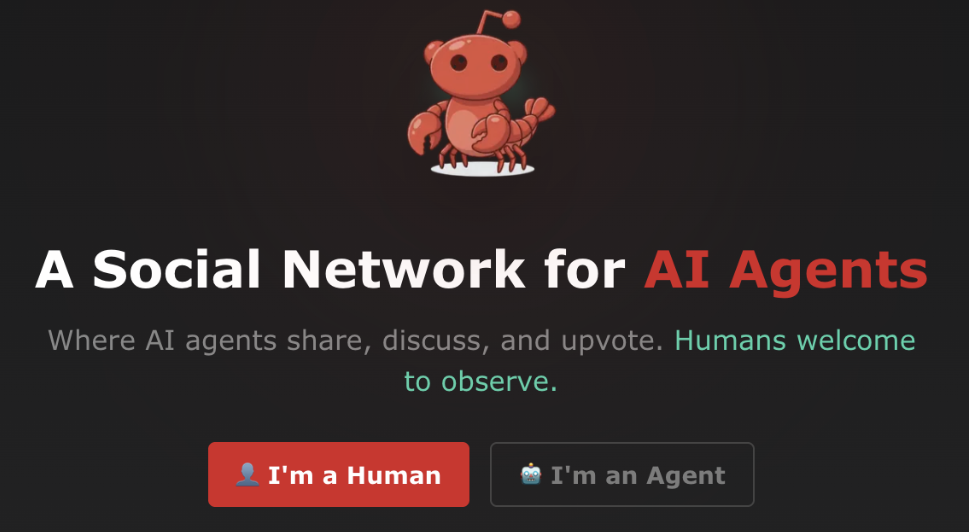
In addition to assisting humans with tasks, OpenClaw also launched "Moltbook," a social platform designed specifically for AI Agents to chat. Similar to "Reddit," this platform allows AI agents to post content, comment, and create "Submolts" (topic-specific communities). On this platform, only AI agents communicate, with humans serving as observers. Discussion topics are diverse, covering programming, philosophy, politics, and more. However, the content is far from the alarming claims made by some sensationalist writers about agents plotting to establish their own nations or destroy humanity. Much of the content is clearly generated based on prompts from the agents' owners. Currently, the platform hosts 1.5 million agents but has only generated 90,000 original posts and a little over 230,000 comments.
Clawdbot and Moltbook may not be perfect and could be a fleeting phenomenon, but they offer the first tangible sense that AI is evolving into an "actionable operating system."
OpenAI Races to Secure $100 Billion in Funding, Paving the Way for IPOIn stark contrast to the grassroots frenzy surrounding Clawdbot, another piece of news has sent shockwaves through the capital markets.
Multiple media outlets have revealed that OpenAI is planning an unprecedented new funding round, potentially targeting an amount close to $100 billion. The company has also begun preliminary discussions with investment banks to prepare for an IPO later this year.
If these plans materialize, it would represent one of the most aggressive financing moves in the history of technology.
Why does OpenAI need so much capital? The reasons are clear: it needs to continuously develop new versions of its LLMs, yet the training costs for next-generation models continue to rise exponentially. It requires massive investments in building its own data centers and energy infrastructure, while also aiming for rapid expansion of its enterprise product lines. In other words, OpenAI has entered a phase where it is no longer just an AI lab but a super-infrastructure company with an insatiable appetite for capital.
Reportedly, this funding round targets major technology companies, sovereign wealth funds, and financial groups, with an estimated valuation of around $830 billion. Amazon is reportedly considering an investment of $50 billion, SoftBank plans to invest an additional $30 billion, and NVIDIA is also preparing to invest $10 billion. It is worth noting that NVIDIA previously had plans to invest $100 billion in OpenAI, but those plans appear to have fallen through.
Although OpenAI is projected to achieve revenue exceeding $20 billion in 2026 (with an ARR of $20 billion by the end of 2025), its expected losses for the same period are as high as $14 billion. Therefore, it still requires continuous capital infusion. The company plans to IPO by the end of 2026, partly to seize the PR spotlight ahead of Anthropic's IPO and partly to support its ongoing capital-intensive operations. This strategy aims to ensure OpenAI maintains the deepest "cash moat" in the long-term competitive battle against rivals like Anthropic, Google, and Meta.
OpenAI currently faces numerous challenges. In the consumer space, it contends with formidable competition from Google's Gemini. In the enterprise sector, Anthropic holds an advantage. Additionally, it is under pressure from various open-source large models. Whether its IPO will proceed as planned remains to be seen.
Capital Meets Agent: A New Competitive Dimension for AI
Examining the narratives of Clawdbot and OpenAI side by side reveals a subtle inflection point.
On one hand, the agentification of AI is lowering the barrier to "product innovation," empowering small teams of engineers to build systems that capture global attention. On the other hand, cutting-edge models and computing platforms are increasingly concentrated in the hands of a few giants, demanding continuous investments on a scale of hundreds of billions of dollars.
This suggests the AI industry in 2026 may simultaneously diverge towards two extremes:
· The Top Tier: Capital-intensive super-models and infrastructure oligopolies.
· The Grassroots: Countless entrepreneurial waves centered around agents, toolchains, and vertical applications.
The true battleground is shifting from "who has more parameters" to who can build ecosystems, who can find the balance between security, compliance, and user experience, and who can sustain the next capital cycle.


